

Overview
SL NEO Digital Signage is a high-performance digital signage and video wall platform for synchronized delivery of video, graphics, information, and dynamic content across single displays, multi-screen installations, and large-format visual environments.
The platform supports up to eight independent 4K@60fps HDMI/DisplayPort outputs on a single server, with synchronized playback, configurable layouts, multi-layer compositions, real-time alpha blending, transitions, and free-form output transformations. Multiple screens can be controlled from a single playlist or operated independently.
SL NEO Digital Signage supports HAP, HAP Alpha/Q, H.264, HEVC, VP9, and AV1 media, together with dynamic text and real-time data from RSS feeds, files, databases, and external systems. Edge blending and geometric correction enable seamless projector and video-wall installations without requiring content to be pre-composed for every display configuration.
Designed for continuous 24/7 operation, the platform can be controlled locally or remotely through desktop and web interfaces and integrated with external applications through API-based workflows.
As part of the SL NEO Media Platform, Digital Signage integrates with media management, graphics, playlist control, and automation modules to support broadcast studios, corporate spaces, transportation hubs, retail environments, event venues, and other professional visual-display applications.


Highlights
Multi-Output 4K Performance
Key Features
- Playback & Performance
- ▸ Output of up to 8x 4K@60fps HDMI/DP video signals on an i9-class CPU
- ▸ Synchronized playback of up to 8x 4K@60fps media files
- ▸ High-performance playback and composition of mixed resolutions and frame rates
- ▸ Supports multiple GPUs for processing
- Multi-Screen & Video Wal
- ▸ Free-form output window transformations
- ▸ Edge blending for multi-screen and video wall layouts
- ▸ Output picture processing and port splitting
- ▸ Multi-camera clips for synchronized multi-screen playback
- Formats & Codec Support
- ▸ Support for HAP, H.264, HEVC, VP9, and AV1 codecs
- ▸ Native support for HAP Alpha and HAP Q Alpha
- Graphics & Layering
- ▸ Up to 10 semi-transparent layers per output
- ▸ Dynamic text overlays
- Content & Data Integration
- ▸ Real-time data input from RSS feeds, files, and external gateways
- ▸ Manual and automated media import
- Playlist & Playout Control
- ▸ Control of all outputs from a single playlist or multiple independent playlists
- ▸ Clip trimming and instant cueing
- ▸ Low-delay playlist operations for immediate operator response
- ▸ Scrubbing and live navigation
- Monitoring & Operation
- ▸ Remote client workstation for media, playlists, and operations
- ▸ Web-based monitoring and control
- ▸ Unattended 24/7 operation
- Integration & Automation
- ▸ API for integration with external applications and workflows
Workflow
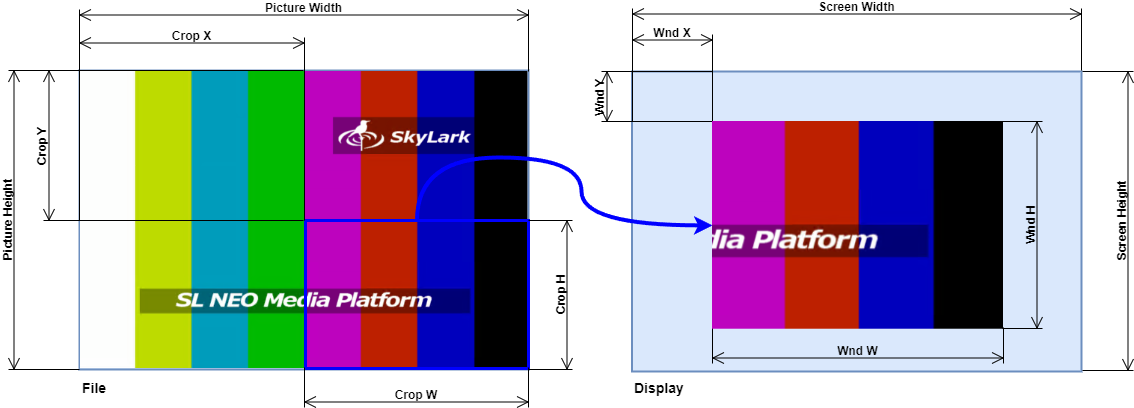
In this mode, the Program module plays a single clip that internally contains images intended for output to multiple displays. The image is played back as a whole and then arbitrarily split before output.
A common use case is a setup where content for four HD screens is pre-composed into a single UHD file. During playback, this UHD image is split and processed as four independent HD signals.
The illustration shows an example of cutting two regions from one playing file and outputting them to two studio screens.

In this mode, all media files are prepared separately as multi-camera clips and are then played back synchronously by the Program module. The key advantage of this approach is that no pre-compositing into a higher-resolution format is required during preproduction.
The illustration shows an example of synchronized playback of two multi-camera clips and their output to two studio screens.

In this mode enables output image adjustments for seamless projector stitching. Supported capabilities include: Distortion compensation - geometric correction of the output image. It enables distortion compensation when a projector cannot be aligned with the
screen's center.
The image illustrates an ideal centered setup, a misaligned projector

When images from multiple projectors overlap, a zone of increased brightness appears. The Edge Blending option applies a smooth brightness gradient along the image edges, resulting in a seamless stitched picture with no visible joins.

Integrated Ecosystem

SL NEO Digital Signage is fully integrated into the SL NEO Media Platform — a modular, software-defined environment where media management, graphics, playlist control, automation, and output modules work together in real time.
Additional modules — including iMAM, Broadcast Graphics, Program Player, and the SL NEO Base Module — can be combined to build centralized digital signage, video wall, and multi-screen content-delivery workflows.
Use Cases
Technical Specifications
SYSTEM
| Chassis | 2U — 4U, dual hot-swap power supplies |
| CPU | 1 or 2 x Intel Xeon or AMD Epyc Series |
| Memory | 48 / 96 GB DDR4 |
| System Drive | SSD for OS |
| Network | 2 x onboard 1GbE |
| Storage | Built-in RAID-10, 4 or 8 x SAS 3.5″ RE drives (4 or 8 TB), useful capacity |
| OS | Windows Server |
Channels
| Mode | HD/SD | Ultra HD |
| Channels | 1 — 8 | 1 — 8 |
I/O Streams: Interfaces, Codecs
| Outputs | HDMI Display Port |
| Video Codecs | HAP HAP Alpha/Q H.264 HEVC VP9 AV1 |
Environments
| Composition Tools | Free-form windows Transforms Edge blending |
| Layers per Output | Up to 10 (semi-transparent) |
| Content Control | Single or multi-playlist Multi-camera clips |
| Control Interfaces | Desktop client Web UI API |
| Data Integration | RSS Files Databases External gateways |
Video Formats & Color Spaces
| Formats | 625i/525i 720p 1080i/1080p 2K 2048×1080p 2160p |
| Frame Rates | 25 / 29.97 / 50 / 59.94 / 60 fps |
All product names, logos, and brands are property of their respective owners.