

Overview
SL NEO Transport Stream Failover is a software-based redundancy solution for continuous monitoring and automatic switching between primary and backup MPEG-TS sources in broadcast, IPTV, cable, and IP distribution workflows.
The platform continuously analyzes incoming transport streams and can detect signal loss, stream interruption, transport errors, bitrate problems, service availability issues, and other configurable fault conditions. When a problem is detected, the system automatically switches to a healthy backup source to maintain uninterrupted output.
Transport Stream Failover supports MPEG-TS over IP and ASI environments and can be used with single services, complete multiplexes, or multiple monitored transport streams. Switching logic, thresholds, delays, priorities, and recovery conditions can be configured according to operational requirements.
As part of the SL NEO Media Platform, Transport Stream Failover integrates with monitoring, playout, multiplexing, and distribution workflows to provide reliable redundancy across broadcast and IP infrastructures.
Highlights
High-Density Processing
Key Features
- Transport Stream Monitoring & Protection
- ▸ Monitoring of up to 32 transport stream pairs (SPTS/MPTS)
- ▸ Continuous analysis of both transport-level integrity and content-level quality
- ▸ Detection of critical stream issues: TS signal loss, Bitrate drop, Continuity Counter (CC) errors, Video black frames, Video freeze (still image), Audio loss / silence, Low audio level / overload
- Intelligent Failover Logic
- ▸ Automatic switching based on number and severity of detected issues
- ▸ Aggregate Source mode for best-signal selection
- ▸ Millisecond-level switching without operator intervention
- ▸ Configurable hysteresis to prevent unnecessary switching
- ▸ Preferred source selection and manual override
- Flexible Input / Output Support
- ▸ MPEG-2 TS over IP and ASI
- ▸ Supported protocols: UDP, RTP, SRT, RIST, Zixi
- ▸ Support for both SPTS and MPTS (DVB / ATSC environments)
- ▸ Seamless integration into existing broadcast and IPTV infrastructures
- Output Stream Continuity
- ▸ Automatic switching without changing destination addresses
- ▸ No impact on downstream systems (transparent failover)
- ▸ Supports aggregate and main/backup workflows
- ▸ Maintains uninterrupted output stream delivery
- Redundancy & High Availability
- ▸ Supports redundant deployment (main/backup failover nodes)
- ▸ Automatic takeover in case of server failure
- ▸ Eliminates single points of failure in the delivery chain
- ▸ Designed for 24/7 broadcast operation
- Stream Processing & Control
- ▸ Service selection and PID remapping
- ▸ Pass-through processing without re-encoding
- ▸ Compatible with upstream QC and muxing workflows
- ▸ Can be used before multiplexing, packaging, or delivery stages
- Monitoring & Integration
- ▸ Web-based user interface for configuration and control
- ▸ SNMP support for monitoring and alarm reporting
- ▸ REST API for automation and integration
- ▸ Alarm-based decision logic available to external systems
Workflow
TS Failover ensures uninterrupted delivery by intelligently selecting the best available feed. It supports dual-source inputs — such as the same signal delivered over different paths (internet / satellite) or streams from main and backup servers — and automatically switches when quality issues are detected.
To optimize operational costs, the backup feed can remain inactive while the primary feed is healthy and is only activated when required, ensuring reliability without unnecessary bandwidth or subscription expenses.
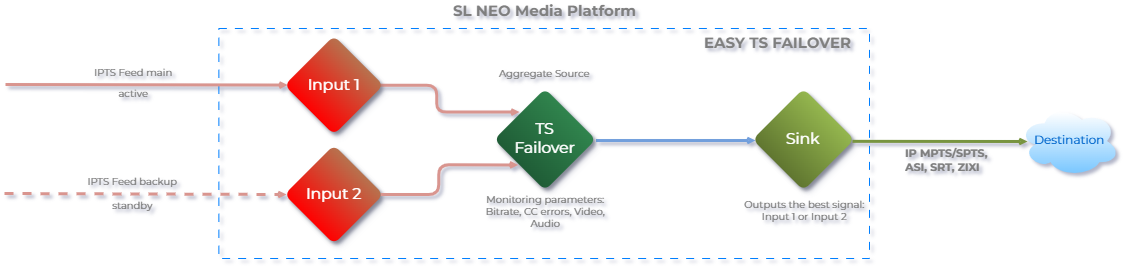
TS Failover keeps your streams on air by automatically switching between main and backup outputs when issues occur—without changing destination addresses or reconfiguring downstream systems.
To ensure end-to-end resilience, TS Failover itself can be deployed in a redundant configuration. Paired modules monitor each other, and if one fails, the backup instantly takes over and continues streaming to the same multicast address, eliminating single points of failure in the broadcast chain.

Integrated Ecosystem

The SL NEO EASY TS FAILOVER is fully integrated into the SL NEO media services platform — a modular, software-defined environment where specialized modules operate together in real time across one or more hardware platforms.
Additional modules — including Easy Muxer, QC, and other workflow components — can be integrated to create a fully tailored broadcast solution:
Use Cases
Technical Specifications
SYSTEM
| CPU | Intel® Xeon® Scalable and AMD Epyc Series |
| Memory | 32GB to 512GB |
| GPU | Nvidia Quadro RTX series |
| OS Drives | 2 x 480GB SSD |
| Management | Web User Interface |
| Interfaces | Up to 32 x ASI 4 x 1GbE-T and/or 4×10GbE-T or 2×25G SFP28 |
| Power | Dual redundant power supplies |
| Dimensions | 1RU or 2RU appliance |
Supported Streams
| Protocols | UDP, RTP, SRT, RIST, Zixi, ASI |
| Formats | UHD: 2160p50/60M/60 HD: 1080p50/60M/60, 1080i50/60M/60, 1080p24M/24/25/30/30M, 720p50/60M/60 SD: PAL, NTSC |
| Stream Types | MPTS/SPTS, DVB, ATSC |
| Embedded ANC / MPEG2 Data Processing | OP-42/47 Teletext and Closed Captions CEA-608/708 Closed Captions DVB/ATSC Subtitles & EPG Data in SPTS SCTE-104/35 with metadata VBI/VANC Data: VITC, AFD, WSS |
Additional Parameters
| Switching Mode | Automatic, manual override supported |
| Switching Logic | Aggregate Source with best-signal selection |
| EPG Support | Static & dynamic insertion |
| Control & Monitoring | Web UI, SNMP, REST API |
All product names, logos, and brands are property of their respective owners.