
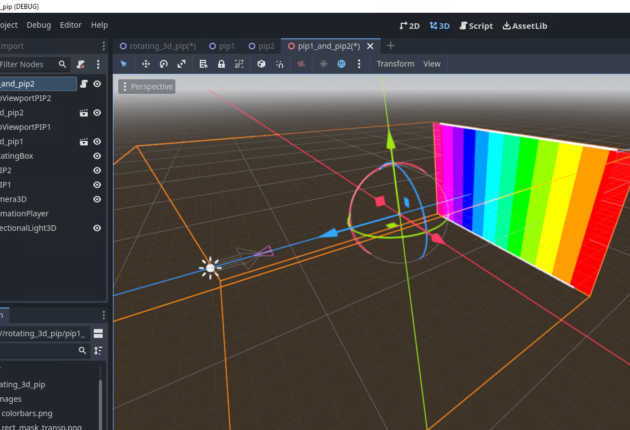
The new module allows broadcasters to create rich 3D transitions, hybrid 2D/3D graphics, and fully interactive applications such as virtual studios, sports visualizations, and immersive on-air experiences — all within a unified production environment.
Key Capabilities
- Flexible operation modes — run as a standalone interactive 3D application or as a fully automated broadcast component
- Seamless media integration — ingest live streams and media assets as real-time textures inside the 3D engine
- Full pipeline compatibility — use 3D outputs across standard workflows including playout, recording, and live production
- Real-time data-driven graphics — integrate RSS feeds, counters, and external data directly into 3D scenes
- Event-driven control — synchronize media server events with 3D logic and trigger actions across the system
- Support for live inputs — incorporate camera feeds and real-time signals into immersive environments
- Free-D protocol support — enable advanced virtual studio workflows with camera tracking and positional data
This integration bridges traditional broadcast infrastructure with modern game engine technology, delivering next-generation graphics, interactivity, and production flexibility.
A major step toward software-defined, visually dynamic broadcast environments.